
Understanding Swiss Tournament System with Quality Scoring
A Swiss tournament is a great competition format where players are paired against opponents with similar performance records in each round. Unlike elimination tournaments where losers are eliminated, every participant plays in every round (or receives a bye if there’s an odd number of players).
You can learn more in our full guide here: Swiss System – A Fair and Flexible Tournament Format (Complete Guide)
We have prepared one Swiss tournament simulation that is used for small amateur badminton events, where local players want to enjoy the day and play competitive matches against opponents of similar skill levels. This format ensures everyone gets maximum playing time while maintaining fair and balanced competition throughout the tournament. Whether you’re organizing a club championship, a recreational weekend event, or a social tournament, the Swiss system with quality scoring creates an engaging experience for all participants.
Key Benefits of swiss tournaments:
- Fair competition – Players face opponents of similar skill level as the tournament progresses
- No elimination – Everyone gets to play the full tournament
- Efficient – Requires fewer rounds than round-robin (playing everyone)
- Competitive balance – Stronger players naturally rise to the top through progressive pairing
Tournament Configuration Example
Basic Setup
- 11 Participants (Participant 1 through Participant 11)
- Match Format: Played Sets – 2 sets per match, each to 21 points, win by 2
- Number of Rounds: 5 rounds (standard for 11 players)
- Deuce Cap: 30 points maximum
- Allow Deuce: Yes
Initial Seeding (Round 1)
The participant list is split in half:
- Top Half: Participants 1-5
- Bottom Half: Participants 6-11
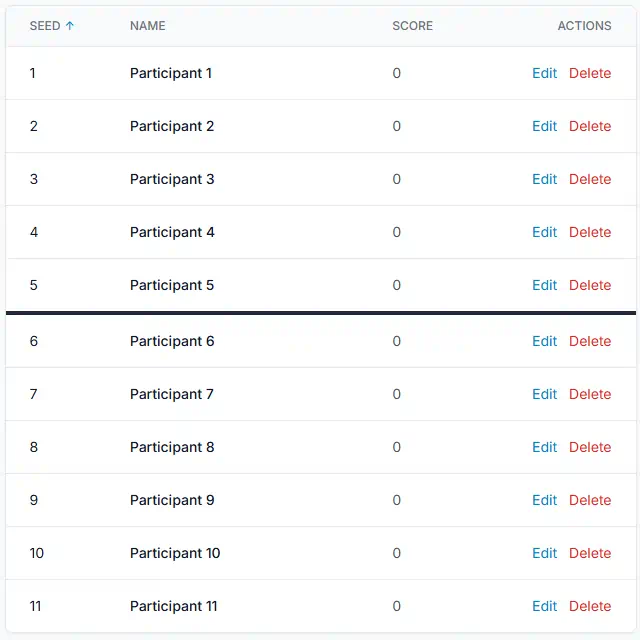
Players from the top half are paired against players from the bottom half:
- P1 vs P6
- P2 vs P7
- P3 vs P8
- P4 vs P9
- P5 vs P10
- P11 receives BYE
Quality Scoring: SET Mode Explained
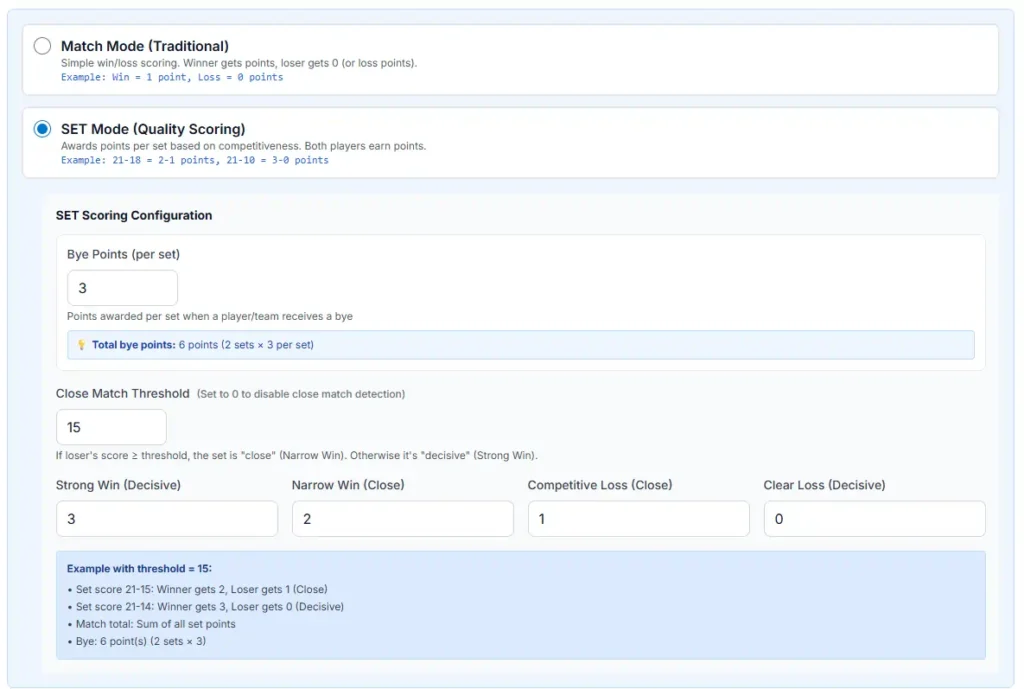
Unlike traditional scoring (Win = 1 point, Loss = 0 points), SET Mode rewards match competitiveness. Both players can earn points based on how close the set was.
Scoring Rules
For each set, points are awarded based on the loser’s score:
- Clear win: 3 points for each set
- Weak win: 2 points (close match – the opponent got at least 15 points)
- Competitive loss: 1 point (15 and more points)
- Clear loss: 0 points
- Close Match Threshold: 15 points
Examples:
- Set score 21-10: winner gets 3 points (decisive), loser gets 0 points
- Set score 21-18: winner gets 2 points (close), loser gets 1 point
Why Quality Scoring?
Traditional scoring doesn’t distinguish between a dominant 21-5, 21-7 victory and a hard-fought 25-23, 24-22 battle. SET MODE rewards competitive play even in defeat, encourages fighting for every point, creates more accurate skill rankings and makes every set meaningful to the standings.
Round-by-Round Simulation
ROUND 1: Initial Pairings (Halving Method)
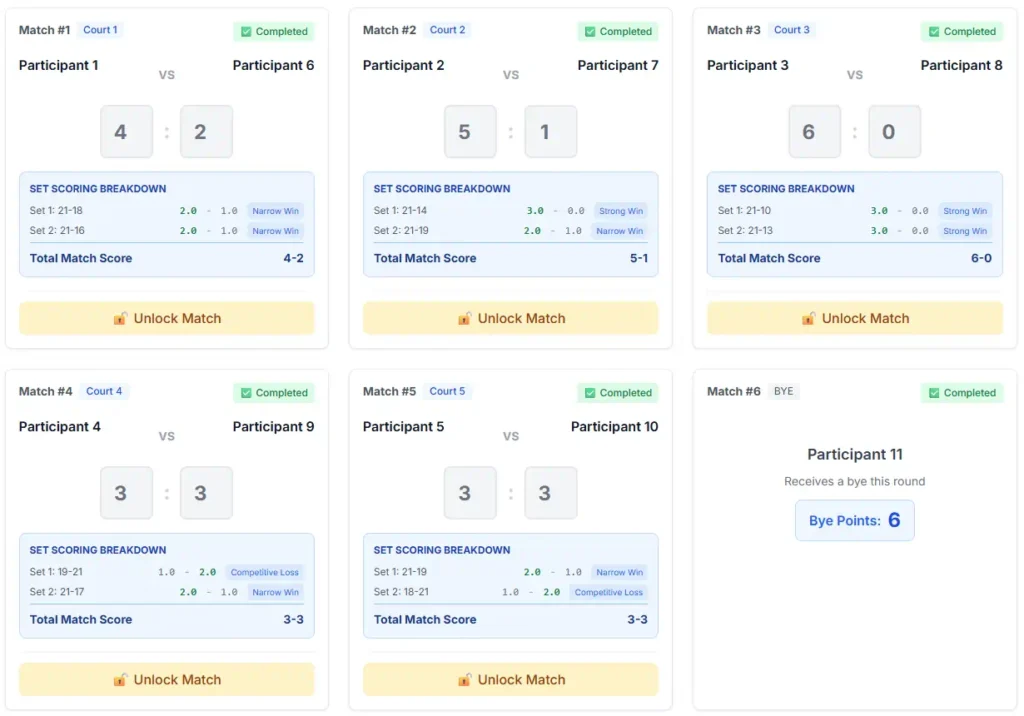
BYE: Participant 11 → Automatic 6 points (3 per set × 2 sets)
| Match # | Pairing | Set 1 | Set 2 | P A Pts | P B Pts | Analysis |
| 1 | P1 vs P6 | 21-18 | 21-16 | 4 | 2 | Both sets close (>15) → P1: 2+2, P6: 1+1 |
| 2 | P2 vs P7 | 21-14 | 21-19 | 5 | 1 | First decisive, second close → P2: 3+2, P7: 0+1 |
| 3 | P3 vs P8 | 21-10 | 21-13 | 6 | 0 | Both sets decisive (≤15) → P3: 3+3, P8: 0+0 |
| 4 | P4 vs P9 | 19-21 | 21-17 | 3 | 3 | Split sets, both close → P4: 1+2, P9: 2+1 |
| 5 | P5 vs P10 | 21-19 | 18-21 | 3 | 3 | Split sets, both close → P5: 2+1, P10: 1+2 |
Round 1 Standings
There are many variations how organizers can sort players and handle tiebreakers.
| Rank | Participant | Points | Notes |
| 1 | P3 | 6 | Dominant 2-0 win (both sets decisive) |
| 2 | P11 | 6 | Bye – automatic points |
| 3 | P2 | 5 | Strong 2-0 win (1 decisive, 1 close) |
| 4 | P1 | 4 | Clean 2-0 win (both sets close) |
| 5-8 | P4, P5, P9, P10 | 3 | All split sets 1-1 |
| 9 | P6 | 2 | Lost 0-2 but both sets were competitive |
| 10 | P7 | 1 | Lost 0-2 (1 decisive loss) |
| 11 | P8 | 0 | Lost 0-2 (both sets decisive losses) |
Hierarchy: Points (SET Mode total) > Buchholz (sum of opponents’ points) > Buchholz Cut-1 (Buchholz excluding lowest opponent) >Sets Won (total sets won) >Initial Seed
Bye Treatment: Points: 6 (full compensation); W: 1 (counts as win); Sets Won: 0; G+: 0, G-: 0; Bye round is excluded from Buchholz calculation
Key Observation: Notice how Participant 6, despite losing 0-2, has more points than P7 and P8 because both sets were close. This is the power of quality scoring.
ROUND 2: Swiss Pairing
In Swiss tournaments, players are paired based on their current standings. Let’s use the Dutch system with score grouping (by points). Within groups: sort by tiebreakers, split in half, pair top vs bottom; Floating for odd groups (lowest floats down); Bye to lowest-ranked player without previous bye.
Players with similar point totals face each other. You can see the Swiss system in action:
- Top performers (P11, P3) faced each other
- Mid-table players (P4 vs P5) had competitive matches
- Lower-ranked players (P6 vs P7) fought to improve standings
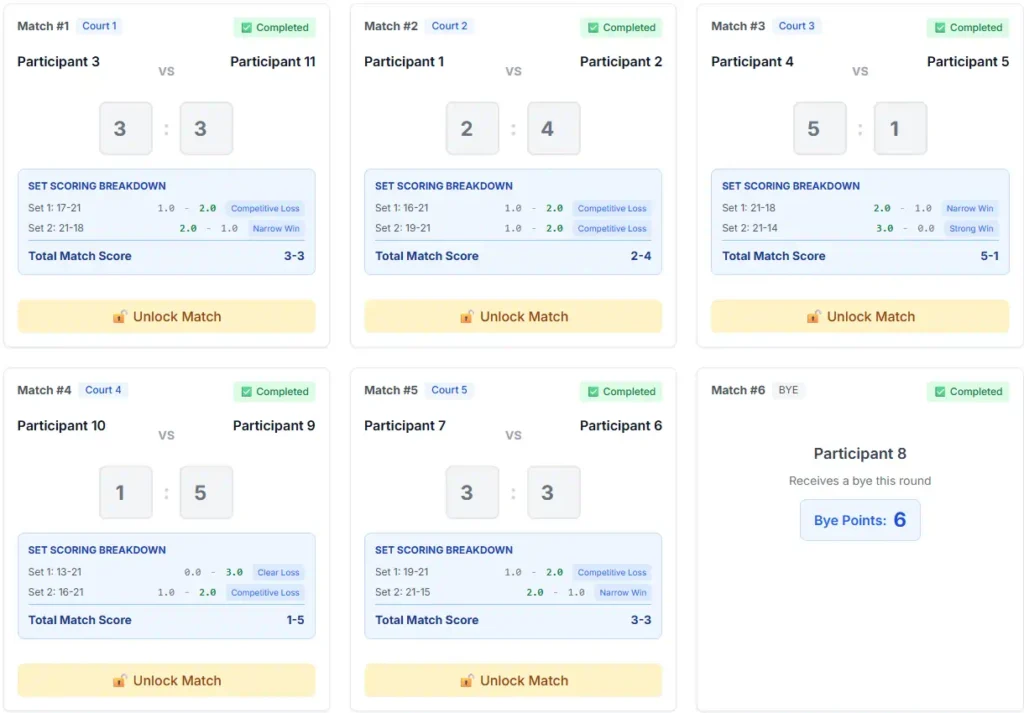
- BYE: Participant 8 (lowest-ranked player without previous bye) → 6 points
Pairings based on Round 1 standings:
| Match | Pairing | Set 1 | Set 2 | P A Pts | P B Pts | Round Pts |
| 1 | P11 vs P3 | 21-17 | 18-21 | 3 | 3 | Split, both close |
| 2 | P2 vs P1 | 21-16 | 21-19 | 4 | 2 | P2 wins 2-0, both close |
| 3 | P4 vs P5 | 21-18 | 21-14 | 5 | 1 | P4 wins (1 close, 1 decisive) |
| 4 | P9 vs P10 | 21-13 | 21-16 | 5 | 1 | P9 wins (1 decisive, 1 close) |
| 5 | P6 vs P7 | 21-19 | 15-21 | 3 | 3 | Split, both close |
Round 2 Cumulative Standings
| Rank | Participant | Total Points | Match Record |
| 1 | P2 | 9 | 2-0-0 |
| 2 | P11 | 9 | 1-0-1 |
| 3 | P3 | 9 | 1-0-1 |
| 4 | P9 | 8 | 2-0-0 |
| 5 | P4 | 8 | 2-0-0 |
| 6 | P8 | 6 | 0-1-0 + bye |
| 7 | P1 | 6 | 1-1-0 |
| 8 | P5 | 5 | 0-2-0 |
| 9 | P6 | 5 | 0-1-1 |
| 10 | P10 | 4 | 0-2-0 |
| 11 | P7 | 4 | 0-1-1 |
ROUND 3
BYE: Participant 10 (lowest-ranked without previous bye) → 6 points
| Match | Pairing | Set 1 | Set 2 | P A Pts | P B Pts | Analysis |
| 1 | P2 vs P11 | 19-21 | 21-17 | 3 | 3 | Split sets, both close |
| 2 | P3 vs P4 | 21-16 | 19-21 | 3 | 3 | Split sets, both close |
| 3 | P9 vs P8 | 21-13 | 21-16 | 6 | 0 | P9 dominant (1 decisive, 1 close) |
| 4 | P1 vs P6 | 21-12 | 21-16 | 6 | 0 | P1 dominant (1 decisive, 1 close) |
| 5 | P7 vs P5 | 21-17 | 21-18 | 4 | 2 | P7 wins both close |
Round 3 Cumulative Standings
RankParticipantTotal PointsMatch Record1P11133-0-02P3132-0-13P9122-1-04P8121-1-1 (bye)5P2112-1-06P4112-1-07P691-1-18P1090-2-1 (bye)9P181-2-010P760-2-111P550-3-0
ROUND 4
BYE: Participant 5 (lowest-ranked without previous bye) → 6 points
Top table clash: P11 (13 pts) vs P3 (13 pts) – battle for tournament lead
MatchPairingSet 1Set 2P A PtsP B PtsAnalysis1P11 vs P321-1822-2042P11 edges both tight sets2P9 vs P821-1621-1742P9 wins both close3P2 vs P419-2121-1833Split sets, both close4P6 vs P1021-1421-1951P6 wins (1 decisive, 1 close)5P1 vs P721-1621-1351P1 wins (1 close, 1 decisive)
Round 4 Cumulative Standings
RankParticipantTotal PointsMatch Record1P11174-0-02P9163-1-03P3152-1-14P2142-1-15P4142-1-16P8141-2-1 (bye)7P6142-1-18P1132-2-09P5110-3-1 (bye)10P10100-3-1 (bye)11P770-3-1
Key Development: P11 pulls ahead with 4 straight wins. P9 moves into clear second place. The middle pack (P2, P4, P8, P6) all tied at 14 points.
ROUND 5: Final Round
BYE: Participant 7 (lowest-ranked without previous bye) → 6 points
This is the decisive round that will determine final placements!
MatchPairingSet 1Set 2P A PtsP B PtsAnalysis1P11 vs P921-1721-1942Championship match: P11 wins close2P3 vs P221-1621-1842Battle for 3rd: P3 wins3P4 vs P821-1521-1751P4 wins (1 decisive, 1 close)4P6 vs P119-2121-1733Split sets, both close5P5 vs P1021-1821-1642P5 wins both close
Final Tournament Results
RankParticipantTotal PointsMatch W-L-DSets W-LKey Performance Notes🥇 1P11215-0-010-0Perfect record, dominated throughout🥈 2P9183-2-06-4Strong mid-tournament, close final🥉 3P3193-1-17-3Consistent, only loss to champion4P4193-1-17-3Tied with P3, lower Buchholz5P2162-2-15-5Competitive throughout6P6172-2-15-5Better quality wins than P27P1162-2-15-5Even record, mid-table finish8P8151-3-13-7Bye round 2 helped standings9P5151-3-13-7Late win improved position10P10120-4-11-9Struggled, bye round 311P7130-4-12-8Tough tournament, bye round 5
Tiebreakers
P3 vs P4 (both 19 points, both 3-1-1): When players tie on points AND match record, Buchholz score (sum of opponents’ total scores) is used as the primary tiebreaker. This rewards playing against stronger opponents throughout the tournament.
P2 vs P6 vs P1 (all 16-17 points range): Despite similar match records (2-2-1), P6’s 17 points come from higher-quality wins (more decisive victories), while P2 and P1 had closer matches resulting in fewer total points.
Key Insights from This Tournament
1. Quality Scoring Creates Nuance
- P6 finished 6th with 2-2-1 record (17 pts) by winning sets decisively
- P2 finished 5th with same 2-2-1 record but only 16 pts from closer matches
- P1 also 2-2-1 but finished 7th with 16 pts – showing how quality of wins matters
2. Five Rounds Provides Clear Separation
- Champion P11 went undefeated 5-0-0 with 21 points
- Clear podium: P9 (18 pts), P3 (19 pts), P4 (19 pts)
- Bottom tier clearly separated from middle pack
- Enough rounds to overcome a poor start or lucky draw
3. Byes Are Fair but Not Dominant
- P11 received Round 1 bye (6 pts) → Finished 1st (21 pts) – won on merit
- P8 received Round 2 bye (6 pts) → Finished 8th (15 pts)
- P10 received Round 3 bye (6 pts) → Finished 10th (12 pts)
- P5 received Round 4 bye (6 pts) → Finished 9th (15 pts)
- P7 received Round 5 bye (6 pts) → Finished 11th (13 pts)
- Every player received exactly one bye – perfectly fair
4. Swiss Pairing Creates Balanced Competition
- Each round matched similarly-performing players
- Top players faced each other in later rounds (P11 vs P3 in R4, P11 vs P9 in R5)
- Lower-ranked players had winnable matches to improve standings
- No “dead” matches – every game mattered for final placement
5. Match Record ≠ Final Ranking
P3 and P4 both finished 3-1-1, but quality of performance differentiated them:
- Both earned 19 points total
- Tiebreaker (Buchholz – opponent strength) determined final placement
- Shows importance of both winning AND who you beat
Why Swiss + Quality Scoring Works
Traditional Problems Solved
ProblemSwiss + SET Mode SolutionMismatched skill levelsProgressive pairing ensures balanced matchesPlayers giving up in lossesLosing competitively still earns pointsWin-at-all-costs mentalityClose wins and dominant wins worth different amountsLimited playing timeEveryone plays all roundsUnfair early eliminationsNo elimination - all players compete fully
Best Use Cases
Perfect for:
- ✅ Badminton, table tennis, squash tournaments
- ✅ Esports competitions with clear set structures
- ✅ Tournaments with limited time (fewer rounds than round-robin)
- ✅ Mixed-skill events (recreational to competitive players)
- ✅ Club championships and league play
Consider alternatives for:
- ❌ Small fields where round-robin is feasible (everyone plays everyone)
- ❌ Spectator-focused events needing clear brackets
- ❌ Sports without natural set divisions
Conclusion
Swiss tournaments with quality scoring create fair, engaging competitions where:
- Every match matters to every player
- Skill level is accurately reflected in standings
- Competitive spirit is rewarded even in defeat
- Tournament organizers can run efficient events
This simulation showed how 11 players completed a 5-round tournament with balanced competition throughout. The combination of Swiss pairing (matching similar performers) and SET Mode scoring (rewarding match quality) created a ranking system that accurately reflected both wins and competitive performance.
Key takeaway: Five rounds allowed enough matches for:
- A clear champion to emerge (P11 with perfect 5-0 record)
- Proper separation of skill levels across all tiers
- Every player to receive one bye (maintaining fairness)
- Competitive matches in every round (no meaningless games)
Appendix: Tournament Format Details
Match Format: “Played Sets”
In this format, all scheduled sets are played regardless of match outcome:
- 2 sets always played (not best-of-3 where third set is conditional)
- Each set to 21 points, win by 2
- Maximum 30 points (deuce cap)
- Both sets contribute independently to tournament points
SET Mode Calculation Formula
For each set:
IF loser_score <= close_match_threshold (15):
    winner_points = 3 (Strong Win)
    loser_points = 0 (Clear Loss)
ELSE:
    winner_points = 2 (Narrow Win)
    loser_points = 1 (Competitive Loss)
Total match points = Sum of all set points (2 sets × scoring)
Bye Calculation
bye_points = bye_points_per_set × number_of_sets
bye_points = 3 × 2 = 6 points
Bye points represent “average competitive performance” – not a guaranteed win (which would be 4-6 points), but fair compensation for not playing.
This simulation demonstrates a Turnio tournament configuration using advanced Swiss pairing with quality-based scoring. The system rewards both winning and competitive play, creating fairer and more engaging tournaments.